On the wikipedia entry for Hackney it states that "Hackney Town Hall Square has been developed as a new 'creative quarter'." Oh dear! Ocean is bankrupt, though at least will re-emerge as a cinema soon. Hackney Empire is currently more dark than going (but it's a beautiful place, nevertheless), etc.
It's clearly attempted to move West a bit. Dalston has that creative buzz. The beacons are The Rio Cinema, The Vortex, Arcola and Cafe Oto. Meanwhile bubbling under are some venues such as the Boys Club on Boleyn Road, the Lux Cinema people and innumerable artists. This heartens me despite the arrival of the hen party brigade from Essex on Saturday nights. Thankfully, though not Downstairs.
Meanwhile we have our own square - Gillett - and even a small bit of open space for performances at Dalston Square to come.
But now, when the time is right, where's the money to give us the extra leg up? Nowhere. We have to live in hope however.
It's all happened despite the powers that be at the ACE or the Town Hall, who threw too much at Ocean, Clissold Leisure Centre and placed their bets on Dalston Square rather than Gillett.
I'm glad however that there is now a healthy dialogue with LBH as we search for the resources to consolidate on our successes, and I hope that it appears soon enough.
Saturday, February 12, 2011

Wednesday, February 09, 2011
Vortex benefit, Margate 4 February 2011
Benefit for the Vortex and Margate Jazz Festival at Margate Winter Gardens, 4 February 2011
Jamie Cullum, Ian Shaw, Liane Carroll, Christine Tobin with David Mossman.
Also some photos from party at Harbour Cafe, The Parade Margate.




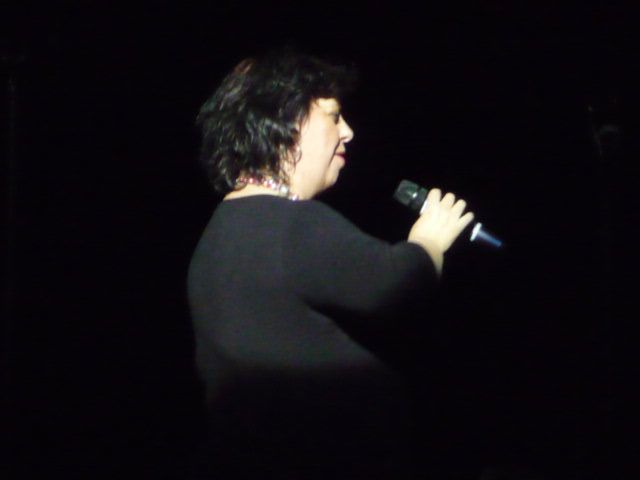


And check out some audio here on Jamie Cullum fan site.
Tuesday, February 01, 2011
Penguin Jazz Guide

(Here are a few thoughts. I'll possibly improve it over the next few days to a proper review, but the assessment is one that I hold to.)
The Penguin Guide has changed form, now being a "best of", as selected by Brian
Morton and the late Richard Cook. In reality, the onus of selection, rather
than review, has been on Morton as Cook died in 2007.
Overall it still links to a monumental task. The reviews seems to be the same, but this time there is an added bonus of a few pertinent quotes from the artist, or savvy musicians. It still makes
enjoyable reading, due to their pithiness.
But part of the fun of the older
editions was that it was
more a tour d'horizon. So there were some fun criticisms and comments.
It was always a joy to try and find out what was in and out and why, especially as both writers are those of immense respect.
The listing is now chronological. The problems with this have been widely
discussed and it is with relief that there will now be an index.
Nevertheless it's fascinating to see how the balance of jazz has changed. The
largest era for recordings is the second half of the 50s. Unsurprising if
one thinks who was going strong then. Still
early enough to record the earliest generation on lp, it was the heyday of
be bop and then.....
But how few Europeans there were until then – just 3 albums up to 1950!
So, overall, if you bought all the albums then your collection would indeed be amazing.
But...
When I've looked at my own speciality in U.K. I have been surprised hy some of
the selections. Arguably Dim Lit by Polar Bear is a good album. But really
the only one to pick from the era of post Loose Tubes-influenced musicians
starting with the "Partisans generation" and onwards via F-IRE and Loop? Tina
May, but no Christine Tobin? Brian Morton called Big Air "one of the most
important Uk albums of the last 25 years" when writing in Jazz Journal. Yet though, it was out in time to be included, but isn't. It would be intriguing to know why there was a reassessment.
A strong
preponderance of improv heavyweights, but do some of the shortcomings also reflect the rest of the scene. I had a chat with a leading French journalist. He though the Martial Solal
choices OK, but not his best.
Of course they can't include what they haven't received, but if they want a
degree of definitiveness then they haven't consulted widely enough.
So a great book with many caveats. The edition with index will once again
bring it closer to the magisterial editions. Worth getting as part of the
way to get albums when building a library. but unfortunately you'll probably
need look at other sources too. The previous full editions were worth it
because they could also warn you off some duff albums/artists. No longer can
it be your only source - or at least 'not yet'! If only though we did have some other choices too.
Monday, January 31, 2011
Evan Parker's "Might I Suggest"

The end of an amazing few days, in emotional and creative terms. was the gig by Stan Tracey, Clark Tracy and Evan Parker.
On several levels: I loved the fact that Stan Tracey and Clark had equal billing. "Stan AND Clark" unlike the usual Stan Tracey Trio WITH Clark Tracey. His playing was amazing for someone aged well over 80, and the delicacy of the duo with Evan was spellbinding.
Other highlights:
Hans Koller giving an outing to his big band and playing the music from his new album
Empirical's new music which sounds so much and extension of Steve Lehman and the New York scene. (Well, Nat Facey has had lessons from Lehman, and they all trekked up to his gig in Birmingham, so what can one expect?) (Funny to hear that George Fogle is not allowed to be a full member of Empirical because they are being marketed as a quartet. The label won't pay for the recording if they convert to a five piece.)
A delicate encore of Evan playing with Django's Beloved Bird. Django playing perfectly placed chords.
(I have to confess that I missed most of the rest of the gig!?)
Alex Hawkins playing "covers" of Leroy Jenkins and Anthony Braxton.
But that ends a 10 day period which also included Ingrid Laubrock's Anti House with new hubby Tom R, and Mary Halvorson, Steve Lehman's first gig in the UK, Phil Robson blowing the house down for 2 nights with Mark Turner, and placed in there too, Mike Westbrook.
So a perfect blend of the statesmen of British jazz, along with the best new sounds from New York, London and a few from elsewhere (e.g. Django's band!)
(P.S. This image is of Stan Tracey with a reflection in the glass of one of the paintings.)
Saturday, January 29, 2011
BBC Russian Service and its importance to jazz!

Leo, while working for the BBC Russian Service, smuggled out of Russia some of the free jazz for which the scene is a better place: Ganelin Trio, Trio Archangelsk. To finance this he released albums by Anthony Braxton, Marilyn Crispell and more.
Leo Records is the upshot. Long may they continue.
Leo was succeeded at the BBC Russian Service by Alexander Kan, himself also a lover of this music, who has brought to UK, inter alia, Evelina Petrova and sorted out tours for the likes of Acoustic Ladyland in Russia.
I hope that this is duly noted by the powers that be as a spin-off of major importance. Politicians need to look beyond the ends of their noses.
There's a bit more about Leo here.
Subscribe to:
Posts (Atom)